



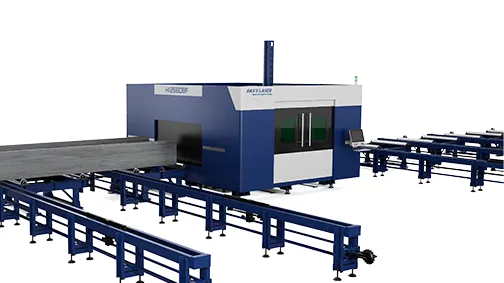
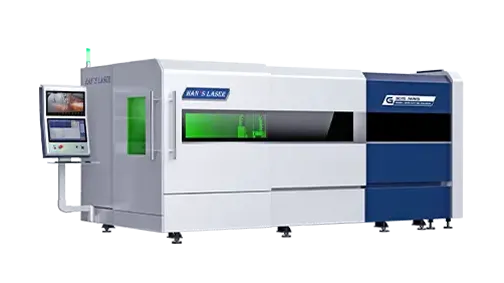


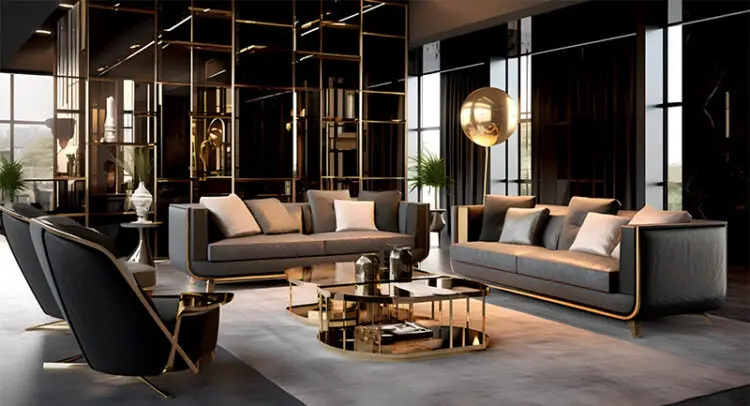
Furniture manufacturing is shifting from mass production to design-driven, customized production. Furniture manufacturers increasingly rely on metal tubing to create frames, support structures, and decorative elements, often utilizing oval, D-shaped, thin-walled square, and other non-standard cross-sections to enhance visual appeal. However, traditional tubing processing methods present numerous challenges that limit production efficiency and product quality.
Challenges in Processing Non-Standard Tubes
Unlike standard round or square tubes, processing non-standard tubes presents a series of unique challenges:
•Clamping Difficulties—Uneven surfaces make it difficult to secure the tubes firmly, which can easily cause part deformation.
•Rotation Difficulties—Asymmetrical shapes require precise angular positioning for every cut.
•Heat Sensitivity—Even with a wall thickness as thin as 1 millimeter, failure to precisely calibrate the laser can cause the tube to warp or burn through.
•Small-Batch Production with Multiple Specifications—Frequent changeovers require reprogramming and reinstalling fixtures, consuming significant production time.
These issues not only reduce production efficiency but also affect the precision of subsequent welding and assembly. Thanks to their speed, flexibility, and precision, laser tube cutting systems have become the preferred processing solution.
Key Technologies for Achieving Flexibility
1.Intelligent Servo Chuck That Adapts to Contour Shapes
Modern laser tube cutting machines utilize servo-controlled chucks with automatic centering capabilities. This system eliminates the need for manual adjustment of the vise; instead, it senses the tube’s diameter and wall thickness and applies just the right amount of clamping force—neither too weak to cause the tube to slip nor too strong to crush thin walls. For irregular cross-sections:
•Multiple contact points distribute the load evenly, preventing localized indentations.
•Built-in torque feedback ensures smooth and consistent rotation.
•An optional third chuck supports longer workpieces, reducing tail end waste.
•In summary: higher concentricity, less vibration, and cleaner cuts even at high rotational speeds.
2.Multi-Axis Motion Control and 3D Cutting Path Planning
Today’s fiber laser platforms combine linear X-Y-Z axes with a rotary A-axis, enabling the beam to follow spatial paths in real time. This is critical when cutting compound bevels, interlocking grooves, or mitered joints in modular furniture frames. The control software can:
•Automatically compensate for variations in the weld gap.
•Apply chamfer angles to prepare joint surfaces.
•Generate arrays of holes or slots based on parametric templates.
•The result: The 100th part has the same precision as the first, with no mechanical adjustments required between batches.
3.Power Optimization for Thin-Walled Tubes
Most furniture tubing is made of low-carbon steel or stainless steel, with wall thicknesses ranging from 1.0 mm to 3.0 mm. Fiber lasers in the 1.5–3 kW range are ideal:
•They are fast enough to maintain short processing cycles.
•The heat-affected zone remains narrow, resulting in minimal edge oxidation,and secondary deburring or grinding is typically unnecessary.
Key Advantage: High-speed processing without compromising the metallurgical integrity of the tubing.
4.Easy-to-Switch Software
In workshops with high-mix, low-volume production, every minute spent on reprogramming or retooling represents a loss of profit. Advanced machines are equipped with the following features:
•Direct import of CAD/CAM models—simply import your 3D model to automatically generate toolpaths.
•Parametric library—stores cutting recipes for every profile, thickness, and connection type.
•Cloud-based dashboard—remotely track machine status, utilization, and job progress.
•Operators can switch from cutting slots in oval tubes to cutting holes in square tubes in five minutes—without changing fixtures or gauges.
5.Automation Ensures Consistent Output
To ensure that laser feeding and finished product unloading require no manual intervention, many systems offer optional loading and unloading modules:
•Servo-driven tubing bundling hopper auto-loading.
•Part sorting conveyors that separate cut parts from scrap frames.
•In-line marking or identification for traceability.
Even with frequent design changes, automation optimizes production cycles and improves overall equipment efficiency.
Case Study: Modular Furniture Workshop
Consider a factory that produces custom shelving and seating systems. On any given day, they might be processing:
•Oval tubes with beveled slots for finger-joint connections.
•Square tubes with punched adjustment holes at varying spacings.
•shaped guide rails with interlocking notches for tool-free assembly.
A single laser tube cutting machine can complete all processes in one go, eliminating the need for separate drilling, milling, or finishing steps.
Conclusion
Advanced laser tube cutting machines offer manufacturers precision, flexibility, and automation. They turn complex geometries into routine operations and convert changeover time into efficient cutting time.
Are you ready to build your custom furniture frames with less waste and greater flexibility? Contact Han’s Laser—our team specializes in smart tube cutting solutions that balance precision, speed, and day-in, day-out reliability. We’ll help you design a system that can be continuously upgraded as your product line expands.


 Previous


 LET’S TALK


